Monday, October 19, 2015

So You Think You Know Britain Part 6

As if navigating London isn't hard enough, there are some streets that are called different names on either side of the street. These signs below are just one example of this. 

Movie ratings are a bit different in the US and UK. Here is a list of US and UK ratings, but the ratings aren't straight across the board. I've seen movies rated R in the US advertised as either 15 or 18 here and movies rated PG-13 rated 12 or 15 here. Also, the 12A rating is for the cinema release and 12 is for the video release. 

US ratings and their UK counterpart:
            
G (general audience)----U (suitable for everyone)

PG (parental guidance)----PG (parental guidance)
                
PG-13 (suitable for 13yo)----12/12A (suitable for 12yo) or 15 (for 15yo)
                          
R (restricted to anyone under 17----15 (suitable for 15yo) or 18 (suitable only for adults)

The legal drinking age in England is 18 which is much lower than 21 in the US. Sixteen and seventeen year olds in the UK can even drink beer, wine, or cider with a meal in a pub if they are accompanied by an adult. 

This Henry vacuum cleaner is super popular here, which surprises me. All vacuums I've seen in the US are nameless, faceless, and upright. Oh, and on this one the hose goes into what appears to be his nose. 

Something else that really surprised me is the language used by Transport for London to explain certain delays. It feels rather insensitive in my opinion. 

I made sure to pack loads of sturdy reusable shopping bags when I moved to London, expecting it to be like the rest of Europe where they charge you for plastic bags. So I was surprised to find that they are only now introducing charges for plastic bags. Too bad I got out of the habit of carrying canvas bags over this last year!

I'm sure this is similar in other large cities, but I am always surprised to see deliveries left on the doorsteps of businesses early in the morning. I suppose theft is rare because otherwise they would stop leaving them unattended. 

I love the honesty of this sign that reads, "Ice Cool Beer." So many times I go to purchase a soda and it is only slightly cooler than room temperature. And ice is not a given in restaurants, either. In the US we like our drinks as cold as possible. An ice cold Coke poured over crushed ice is one of life's joys.

The size of the bill/note increases with the value. In the US all the bills are the same size no matter the value. The £50 note is even larger than the £20, so it can be a real struggle fitting it in an American wallet.

The money here is also taller but shorter than American money, as you can see in the photo below. American wallets also aren't really set up for the amount of coins used. Since we use $1 bills back home coins aren't as valuable and a lot of people throw all their coins in a jar at home and then cash them in when it is full. Here they use £1 and £2 coins so you could easily have over £5 (currently worth over $7.50) just in change in your coin purse at any given time. 


Thursday, October 15, 2015

Shiny New Things

Lemon curd is a smooth fruit spread that is almost like pie filling but with a stronger citrus taste. I know it is available in the US but it seems to be everywhere here in London. I've seen lemon curd yogurt, ice cream, sweet rolls, puddings, and tarts. My favourite lemon curd is this one from Fortnum & Mason and I usually just put it on toast. 

One of my new favourite stores is Telegramme Paper Company. They make these amazing cards and prints. They are really great quality with kraft paper envelopes.

I bought the card below just because I liked the outside design. But then when I got it home and opened it I found that it has two pages of lined paper inside to write an even longer card. 

Telegramme also recently came out with these animal prints and cards. I bought a collection of four because if you buy three cards online you get a fourth for free. I can't wait to see what other cute designs they come up with!

And finally, a new show I've discovered since moving to London is 8 Out of 10 Cats Does Countdown. This is a combination of two shows: 8 Out of 10 Cats (a show where teams of comedians try to guess answers to opinion polls) and Countdown (a gameshow where contestants solve math and word puzzles). In this version, the regular comedians from 8 Out of 10 Cats compete against each other with other guest comedians. It is hard to describe but definitely worth watching. 

Monday, October 12, 2015

Victorian Photography

Photography came to London in 1839 and changed the way people saw their city and fellow residents. I went to the London Metropolitan Archives to see their temporary exhibit about Victorian photography. I love seeing old photographs and these displays were really well done. Below are photos of some of my favourites.

This wall featured photography from a monthly magazine called Street Life in London by journalist Adolphe Smith and photographer John Thompson. They wanted to illustrate their findings about life for the poor to encourage social reform movements. 

The photos below came from a photography album of children who attended a fancy dress (costume) ball at Mansion House in 1899. There were several forms of entertainment at the party including a ventriloquist and the temporary photography studio was set up. 

Until the eighteenth century, London Bridge was the only way to cross the Thames River in London. The photo below shows the construction of Tower Bridge, now London's most famous bridge.

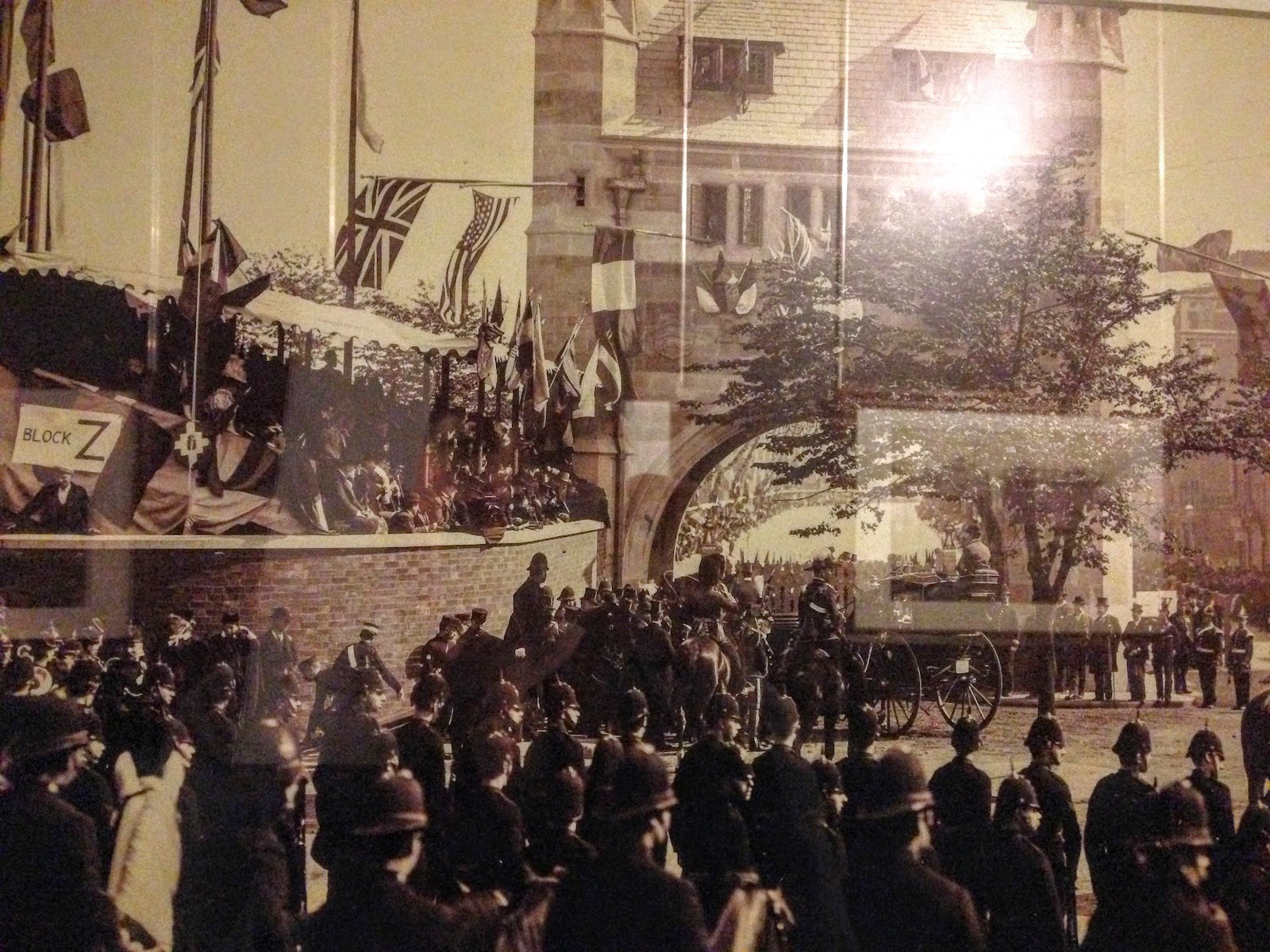
This next photo shows the opening of the Blackwall Tunnel which was attended by then Prince of Wales, Edward VII. The tunnel was another way to cross the river, this time going under the water, and combined foot, cycle, horse-drawn and automobile traffic. 

The photo below was one of my favourites from the exhibit. It shows the construction of a tunnel for the underground at Baker Street, which is a location now very familiar to me. They used an innovative cut and cover construction method to reduce costs and disruption. 

Lining the hallway were reprinted photographs from the Greenwich Heritage Centre. These street scenes included fish hawkers (and a hopeful cat), a champion pie maker, dairy vendor, buskers, and a young boy on a "Try Your Weight" machine. 

The photo below on the left shows a woman selling sherbet (a fizzy drink) while the one on the right shows a man selling ginger cakes. I love seeing how much has changed from these street vendors to the ones I purchase food from today. 

Thursday, October 8, 2015

Animals in War Memorial

On the edge of Hyde Park is a beautiful monument to the animals who served and died in World War I and II. I pass this memorial at least once a week on the bus and it always makes me a bit sad. I've always been very tender-hearted when it comes to animals suffering so I decided to get a closer look at the statues and carvings. 

"They had no choice" is such an accurate description of the use of animals in war. So many of them showed exemplary heroism and they didn't even know what it was for. 54 animals received the Dickin Medal(an animal's Victoria Cross or Medal of Honor) including 32 pigeons, 18 dogs, and 3 horses. 

Rip the dog was one of these animals awarded with the Dickin Medal. He was a stray found in Poplar by an Air Raid warden and became the service's first search and rescue dog. Rip wasn't trained in search and rescue but he took to it instinctively. In one year, he found over a hundred victims of air raids in London. He wore his Dickin Medal on his collar until the day he died. 

Simon the cat was the ship's cat on the HMS Amethyst. As a malnourished kitten he was found wandering the dockyards in Hong Kong and taken aboard. He was known for his cheekiness because he would leave dead rats in sailor's beds and slept in the captains cap. He was wounded by cannon shell during an attack in the Yangtze Incident but survived with help from medical staff. He returned to his duties by managing a rat infestation and raising morale. 

G.I.Joe, a carrier pigeon for the United States Army Pigeon Service, delivered a message stopping the Allies from bombing a town that the infantry division had just taken over. He flew over twenty miles in twenty minutes. He was the first non-British recipient of the Dickin Medal. 

Judy was a ship's dog on the HMS Gnat and HMS Grasshopper. She alerted crew to incoming aircraft, found fresh water for the crew when stranded on a desert island, survived a crocodile attack, and was taken as a prisoner of war, the only dog to be officially considered so in World War II. 
I am so impressed with the sacrifice made by animals during times of war. Now when I pass this monument I'll think of Simon and all the other amazing animals who not only kept up morale but completed important jobs throughout the war. 

Tuesday, October 6, 2015

Things Will Be Great When You're Downton

Last month I toured Highclere Castle with a group of friends. It was perfect timing as we were there days before the final season of Downton Abbey started airing in the UK. The house felt very familiar after seeing it on the show for the last 5 seasons. 

The actual Highclere Castle has a fascinating history. It has been the home to the Earls of Carnarvon since 1679. The current home stands on the site of the medieval palace of the Bishops of Winchester, who owned the land since the 8th century. 

The home was remodelled for the third Earl with designs by Sir Charles Barry after he finished the construction on the Houses of Parliament. Barry described the style as "Anglo-Italian" since his design was heavily influenced by Renaissance architecture. 

The library of the home is one that is used so much in the filming of Downton Abbey. The tour is limited to the dining room (where the Grantham family eats breakfast), the great hall, the library, and several bedrooms used by the Grantham family. 

The 5th Earl of Carnarvon was an amateur Egyptologist and even sponsored and accompanied the discovery of King Tut's tomb in 1922. His death in Cairo the following year led to the story of the "Curse of Tutankhamun" but he most likely died from an infected mosquito bite. British celebrities Katie Price and Peter Andre were married at Highclere Castle in 2005 and she blames the curse for her marriage ending in 2009.

The downstairs scenes of Downton Abbey were filmed in London as the basement of Highclere is filled with the family's Egyptian artefacts collection and several cafes where you can have afternoon tea or luncheon, as they would say on the show. 

It is estimated by the insurance company Aviva that it would cost over £500,000 each year to maintain the house and pay staff salaries. It has over 300 rooms including 60 bedrooms and 30 bathrooms plus 170 single glazed windows. The current Earl of Carnarvon and his wife live in the main house during the winter and stay in a cottage on the grounds during the summer to allow for tours to bring in the income needed for repairs. 
Our day at Highclere was so much fun. The grounds are beautiful and I really enjoyed seeing where one of my favourite tv shows is filmed. I love historic homes but especially on a beautiful, clear day. 

Sunday, October 4, 2015

Frogmore House

I visited Frogmore House and the Royal Mausoleum in August with my friend Cierra. The house and grounds are only open to the public a few days a year so I was excited to go. The Royal Mausoleum contains the tomb of Queen Victoria and Prince Albert. They long planned to build a structure as a special resting place for the two of them but construction only began after Albert passed away in 1861.

Visitors can't go inside the mausoleum because the structure is unsafe. One of the guides told us that it has been damaged by the damp (Frogmore is aptly named after the prevalence of frogs who have always lived in the marshy area). 

The Royal Burial Ground surrounds the Royal Mausoleum. Most members of the royal family (except sovereigns and their consorts) have been buried here since 1928. The two graves off to themselves in the photo below are for Prince Edward, Duke of Windsor (formerly King Edward VIII) and his wife Wallis, Duchess of Windsor. One of the guides told us that special permission from Queen Elizabeth II was needed for their bodies to be buried here since he abdicated the throne and was often the cause of controversy for the royal family. 

Frogmore House has been under royal ownership since the 16th century. Queen Charlotte, the wife of King George III, used the house as a country retreat for her and her unmarried daughters. It was then inhabited by one of Charlotte's daughters until her death. In 1840, Queen Victoria gave it to her mother who made many changes to the decor. 

Restoration work in the 1980s to bring back Queen Charlotte's decor revealed lost paintings by Louis Laguerre from the early 18th century shown in the photo below. 

Queen Mary, the wife of George V, arranged Frogmore as a "family souvenir museum." Because of this, some of the rooms in the house seemed really cluttered and busy so it wasn't my favourite historic home I've visited. The sitting room below was one of my favourite rooms, but even this one was pretty over the top.

The grounds of Frogmore House are also beautiful. Queen Charlotte had a great interest in botany and filled the gardens with rare and unusual trees and plants. 
I enjoyed my visit to Frogmore House and especially the Royal Mausoleum. I've seen quite a few royal burial sites so it was interesting to see where Victoria, whose image seems to be everywhere in England, was laid to rest. 

Thursday, October 1, 2015

Brompton Cemetery

Last month, Lisa and I went to the showing of Pan's Labyrinth in Brompton Cemetery. We got there early and walked around the cemetery a bit. The sun was setting and it was really beautiful and peaceful, even though people were flooding in for the movie. 

Brompton Cemetery is one of the oldest garden cemeteries in Britain, dating back to June 1840. The buildings and central path were designed to look like an open air cathedral. 

There are over 35,000 monuments and headstones in Brompton and there have been some 205,000 burials. It was closed for burials from 1952 to 1996 but is currently a working cemetery again. Loads of famous people are buried in Brompton including Dr John Snow (who discovered that cholera is spread by water in 1854) and suffragette Emmeline Pankhurst. 

As for the movie, I really enjoyed Pan's Labyrinth. This was the first time I had seen it and I didn't know much about the plot beforehand. Overall, it was a fun experience even though it was really cold and I couldn't always see the subtitles because people's heads were in the way. 
Outdoor movies are put on every summer so I look forward to doing this again next year. I really like how involved people are with events like these in London. It makes it possible to participate in some really interesting things!